Compete

Four Ways
to Do Science.

Every serious scientific pursuit fits one of four categories. Read each carefully and choose the one that most honestly reflects your work.

Presentation Categories

Find Your Category.

01
“You ran the experiment. Now show the world what you found.”

Original Experimental Research

You designed a study, collected original data, and analyzed what you found, including the parts that didn't go as expected. Judges will scrutinize your research question, methodology, controls, analysis, and willingness to account honestly for the limitations of your own data.

Requirements

  • A research question developed independently, grounded in existing literature
  • Documented methodology another student could replicate
  • Original data from your own experiment, survey, or observational study
  • Analysis using appropriate quantitative or qualitative methods
  • A results section that presents what the data actually shows
  • Discussion of implications, limitations, and future directions

Example Topics

Bacterial growth inhibition under varying antiseptic concentrations, ambient noise and short term recall in adolescents, food insecurity and academic self efficacy

02
“Sometimes the most powerful work happens in the library.”

Literature Review & Analysis

You surveyed the existing research on a topic, identified where scientists agree and disagree, and formed your own analytical conclusions. A strong literature review is not a summary, it is an argument built from evidence, and judges will expect you to defend it.

Requirements

  • A minimum of 5 to 8 credible scientific sources (3 to 5 for the Middle School divisions)
  • Synthesis across sources, not a source by source summary
  • Identification of patterns, contradictions, consensus, and research gaps
  • Original analytical conclusions beyond what any single source states
  • Consistent citation in MLA, APA, or Chicago format

Example Topics

Health disparities in early cancer screening rates, chronic stress and adolescent hippocampal development, antibiotic resistance in gram negative bacteria

03
“You get it better than anyone. Help the rest of us catch up.”

Topic Exploration & Explanation

You've developed genuine mastery of a complex topic, and your goal is to make it understandable, not simplified, but genuinely clear, to an audience encountering it seriously for the first time. Judges will test the limits of your understanding, the board is your starting point, not your ceiling.

Requirements

  • Demonstrated command of the topic beyond surface description
  • Visual aids that genuinely advance comprehension
  • Coverage of both foundational science and current developments
  • Discussion of real world applications or societal implications
  • Credible sources cited throughout

Example Topics

CRISPR Cas9: mechanism, application, and the ethics of germline editing, neuroplasticity across the lifespan, the physics and engineering of nuclear fusion

04
“One moment. One discovery. Infinite implications.”

Case Study Analysis

You selected one specific event, discovery, or phenomenon and examined it with precision. The best case studies use a single, well defined case as a lens through which to examine broader scientific principles or systemic patterns the field has drawn from a specific moment.

Requirements

  • A case specific enough to be examined in genuine depth
  • Detailed scientific and historical background
  • Clear explanation of the science involved
  • Analysis of causes, effects, and significance, not just description
  • Explicit connection to broader scientific principles or open questions

Example Topics

The Chernobyl disaster: reactor physics and long term ecological impact, John Snow's 1854 cholera investigation, the thalidomide crisis and pharmaceutical oversight

Submission Requirements

What Every Competitor Must Prepare.

Tri-Fold Display Board

36" tall x 48" wide, standard tri-fold, fully opened

Your board is the primary visual document of your work. Judges read it independently before, during, and after your verbal presentation, it must stand on its own as a complete scientific record.

  • Title panel: name(s), grade(s), school, and category
  • Introduction: context, research question, and significance
  • Main content appropriate to your category
  • Visual elements that serve your argument directly
  • Conclusion addressing implications and limitations
  • References in MLA, APA, or Chicago, consistent throughout

Abstract

150 to 250 words, submitted as part of your online registration

Your abstract must address: what is your topic and why does it matter, what question are you investigating, how did you approach it, what did you find, and what are the real world implications.

Your abstract is submitted digitally during registration, not collected separately on event day. What you do need on event day is your printed registration confirmation, see below.

What to Bring on Event Day

  • Your printed registration confirmation (required for check-in at the front desk)
  • Your completed tri-fold display board
  • Business attire, see the dress code on the About page
  • Any supplementary materials related to your project

Supplementary Materials

Optional, but strongly encouraged

Physical models, prototypes, demonstrations, or specimens that extend your argument beyond the board.

  • Must fit within your allocated table space
  • Must relate directly to your research
  • Working demonstrations should run reliably throughout judging
  • Decorative elements are fine, provided they don't compete for attention with the science
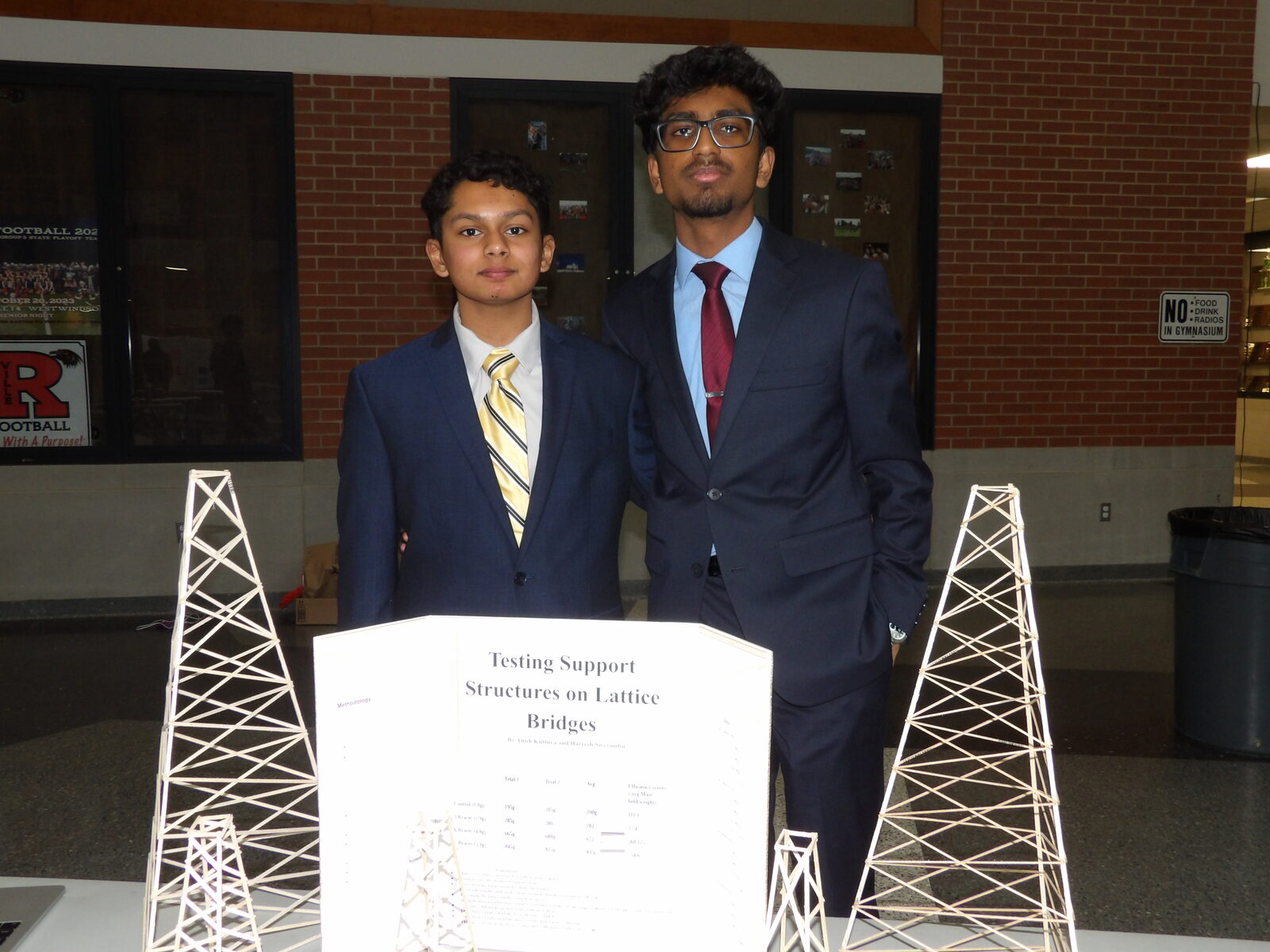
Two SciFest 2026 presenters with physical lattice bridge models supporting their board, Testing Support Structures on Lattice Bridges.
SciFest 2026: physical lattice bridge models built to support an experimental research board
Judging & Expectations

How Your Work Will Be Evaluated.

Projects are evaluated using a point based system. Each presentation is assigned a number to minimize bias during judging, no judge knows whose project they're evaluating. Each grade division is judged separately, with criteria calibrated to that grade level.

Middle School Divisions (Grades 5 to 6 & Grades 7 to 8), Total: 25 points
CriterionPoints
Scientific Understanding & Curiosity8
Clarity of Presentation7
Visual Communication5
Verbal Communication5
Total25

Grades 5 to 6 and grades 7 to 8 are judged on the same rubric above, but compete for separate awards as two distinct divisions.

Division 1

Grades 9 to 10, Total: 24 points

Scientific Content & Understanding (8 points)

Depth of research and accuracy of information. Clear explanation of scientific concepts. Quality and credibility of sources used. Ability to answer questions about the topic.

Visual Presentation & Design (7 points)

Tri-fold organization and logical flow. Effective use of visuals (graphs, diagrams, images). Professional appearance and readability. Creative use of additional presentation elements (models, demonstrations, and more). Overall table aesthetic and effort.

Scientific Communication & Implications (4 points)

Clear explanation of complex concepts. Discussion of real world applications. Connection to broader scientific principles. Identification of limitations or future directions.

Verbal Communication (5 points)

Clarity and confidence in delivery (3 to 5 minutes). Engagement with judges during Q&A. Time management. Enthusiasm for the topic.

Division 2

Grades 11 to 12, Total: 16 points

Scientific Rigor & Analysis (8 points)

Depth and complexity of research. Critical analysis and original insights. Quality of methodology (for experimental projects). Strength of evidence and credible sources.

Visual Presentation & Professionalism (4 points)

Tri-fold organization, clarity, and aesthetic quality. Effective data presentation (charts, graphs, images). Creative and relevant use of additional presentation elements. Professional formatting and attention to detail.

Verbal Presentation & Defense (4 points)

Confident and articulate delivery (3 to 5 minutes). Ability to defend conclusions and answer challenging questions. Demonstration of deep understanding beyond the board. Professional engagement with judges.

Division 2 is scored on a compressed rubric with a higher implied standard per point, a score of 14/16 represents exceptional work.

Tips for Presenters

What the Best Competitors Do Differently.

Know more than your board contains

Your tri-fold documents what you found. Judges want evidence you understand what it means, and what you'd do differently next time.

Practice standing up, in business attire

Reading from your board is the most common and costly mistake. Practice your verbal presentation out loud, at full length, at least five times.

Make every visual earn its place

A chart that needs two minutes of explanation isn't a good chart. If removing a visual wouldn't make the board less clear, cut it.

Cite everything, consistently

Pick one format, MLA, APA, or Chicago, and apply it across every reference on your board and abstract.

Submit your abstract carefully

Your abstract is submitted with your registration, not finalized later. Write, edit, and proofread it before you register.

Prepare for uncertainty

If you don't know an answer, say so, then explain what you think and how you'd find out. Intellectual honesty is a scientific virtue.

Division Breakdown

Four Divisions. One Standard.

Middle School, Grades 5 to 6

Follows the same general framework as high school competitors: tri-fold, registered abstract, business attire, 3 to 5 minute presentation, anonymous evaluation, with two calibrated adjustments: a rubric weighted toward curiosity and clarity, and a reduced source requirement (3 to 5 sources) for literature based categories. Never ranked against grades 7 and up.

Middle School, Grades 7 to 8

Same framework and rubric as the 5 to 6 division, judged as a separate group so seventh and eighth graders compete against peers at their own stage rather than fifth and sixth graders. Never ranked against high schoolers.

Division 1, Grades 9 to 10

Emphasis on scientific understanding, clear and organized visual presentation, and confident verbal communication, calibrated to what a well prepared ninth or tenth grader can reasonably demonstrate.

Division 2, Grades 11 to 12

The highest competitive standard at SciFest. Judges expect not just understanding but analysis: the ability to defend a conclusion, account for methodological weaknesses, and answer questions that weren't anticipated, comparable to presenting at a university research symposium.

Found Your Category?

Registration is open now. There is no limit on the number of presenting groups at this time.

Go to Registration